
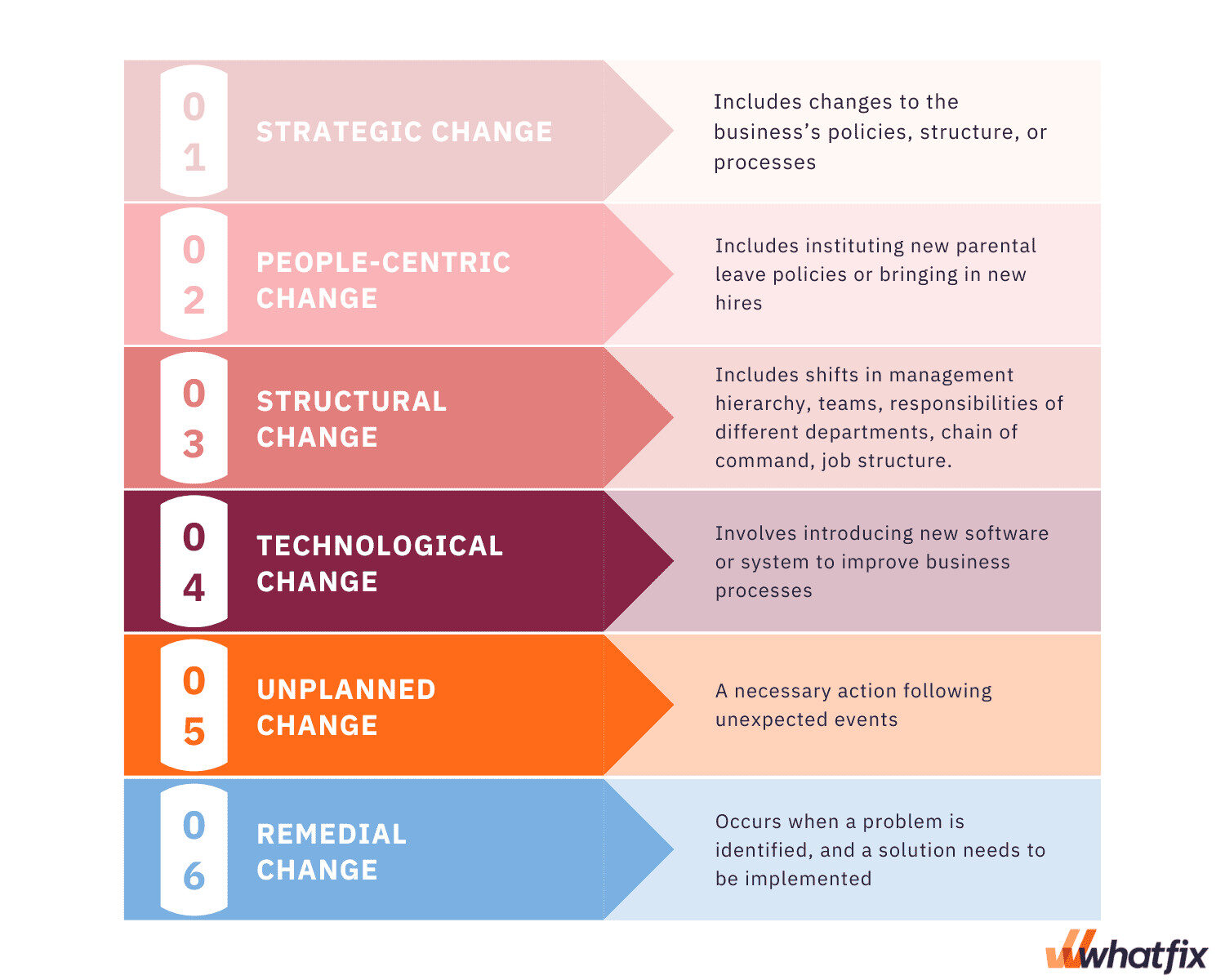
Different types of organizational change require different strategies. Everything from implementation to communication must be tailored to the type of change to be made.
Here are the six most common types of organizational change, along with change management examples for each:
1. Strategic change
Organizations implement strategic changes to their businesses to achieve goals, boost competitive advantage, or respond to market opportunities or threats. A strategic change includes changes to the business’s policies, structure, or processes. Upper management and the Chief Executive Officer are often responsible for strategic change.
Here are three examples of strategic change in an organization:
- Updating your mission as you grow: When companies first launch, the initial focus is often on lead generation and client acquisition. However, once the company has an established customer base, the focus could shift to upselling. When the main mission changes, the company’s mission also needs to evolve.
- Innovation: Strategic change through digital innovation refers to using skills and resources to develop new ideas or improve existing offerings to meet customers’ new and changing demands. Focusing on innovation often requires investing heavily in research and development activities and the latest technology.
- Restructuring: Restructuring leads organizations to reorganize aspects of their company to survive a massive blow or to maximize their already profitable business. Restructuring can result in downsizing or upsizing the workforce. For example, during COVID-19, the tourism and hospitality sectors were two of the worst-hit industries regarding employee lay-offs and losses.
2. People-centric organizational change
While all changes affect people, people-centric organizational changes include instituting new parental leave policies or hiring new hires. When implementing a people-centric change, leaders must remember that employees naturally resist change.
A people‐centric change requires transparency, communication, effective leadership, and an empathetic approach.
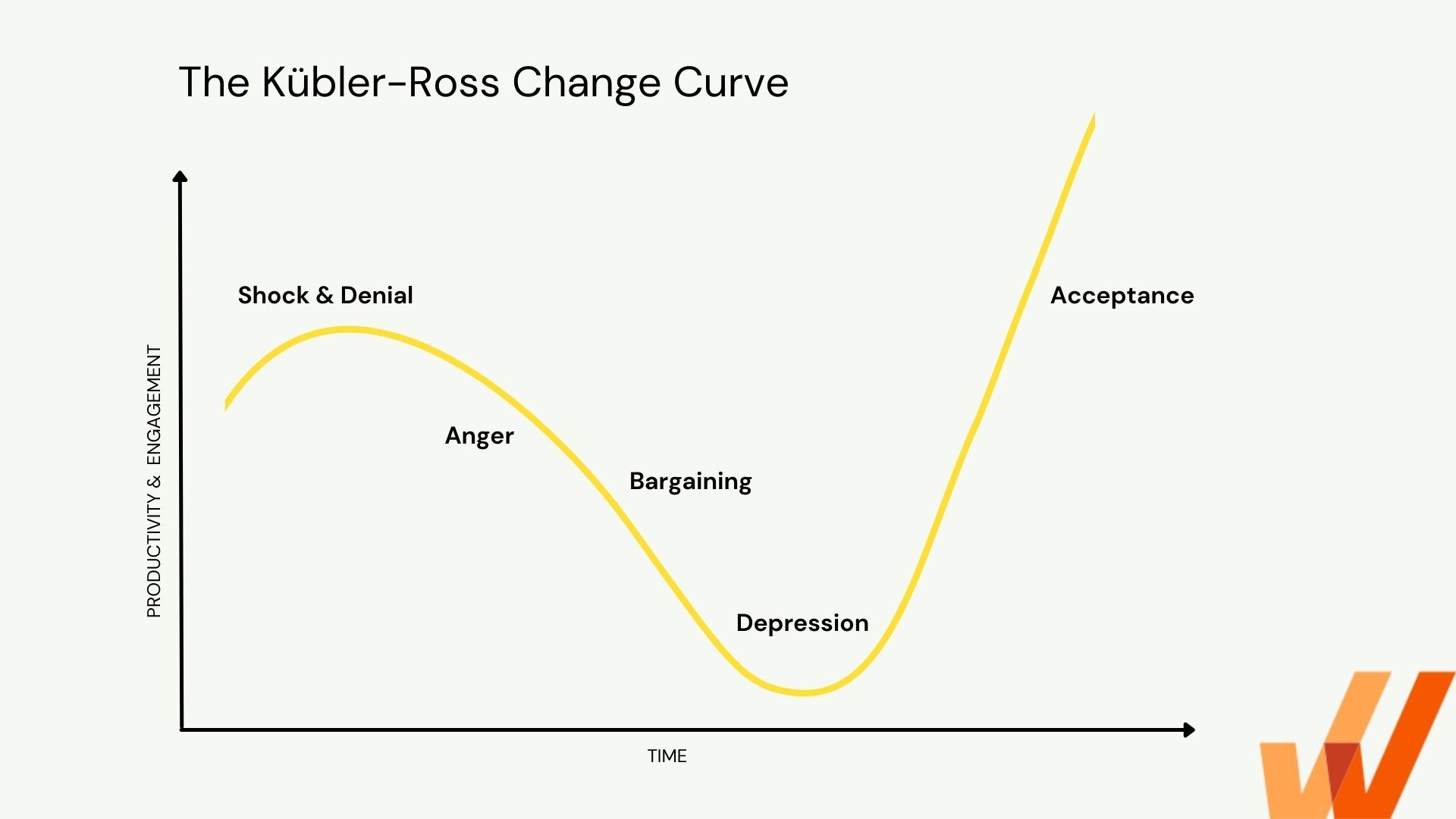
NOTE: Many change management models, such as the Kübler-Ross Change Curve and Satir Change Model, focus on managing emotional reactions to change.
Here are three examples of strategic change in an organization:
| New hire onboarding | Bringing on new team members requires effective onboarding and training, which affect both the new hires and the established employees. You need to start by communicating the reason for hiring new team members. Are they going to lighten the workload? Will they fill in the skills gaps? How will they integrate with the current team? Be ready to answer the above questions and have a solid plan to avoid adverse reactions. Get ahead of concerns like the extra time it will take to train the new employees on existing tools. |
| Changes to roles and responsibilities | Job descriptions can evolve. Changes to an employee’s responsibilities may require additional training or upskilling and team restructuring. Of course, shaking up routines is a delicate process. It’s essential to have a strategy for change implementation and communication. People like purposeful change. Communicating the value of the change is essential. If you add responsibility to someone’s role, the employee will be more likely to receive the news well if they understand its reason. Consider the following options for announcing the new responsibility: Option A: “Starting next month, the marketing team will be required to use Oracle to create monthly reports on email marketing efforts.” Option B: “Oracle’s built-in analytics simplify monitoring email marketing efforts and running reports. Harnessing those analytics will allow us to create detailed reports for clients and offer them more value. Starting next month, the marketing team will be in charge of creating and delivering reports to clients.” |
| Layoffs | If your company undergoes mass hiring or layoffs, forcing you to change your internal operations and processes, the situation has to be dealt with by keeping in mind its impact on both the laid-off and the remaining employees’ morale. Give your laid-off employees enough time to rehabilitate and leave the company without any financial or emotional turbulence. On the other hand, the threat of layoffs might evoke fear and anxiety among your remaining staff members, thereby affecting their morale and productivity. Therefore, the leadership needs to be transparent with these employees, communicate the reasons behind such drastic changes, and answer any employees’ questions regarding the change. |
3. Structural change
Structural changes are changes made to the organization’s structure that might stem from internal or external factors and typically affect how the company is run. Structural changes include major shifts in the management hierarchy, team organization, the responsibilities attributed to different departments, the chain of command, job structure, and administrative procedures.
Circumstances that lead to structural change include mergers and acquisitions, job duplication, changes in the market, and process or policy changes. These changes often overlap with people-centric changes as they directly affect most, if not all, employees.
Here are three examples of strategic change in an organization:
| Mergers and acquisitions | Mergers and acquisitions are the most common cause of structural change. For example, let’s say a company X decided to merge with a company Y. As a part of that merger, duplicate departments are eliminated, employees from both companies are reassigned to new positions, some employees are terminated, new policies and procedures are created, and job functions are realigned to fit the new company structure. Eliminating role redundancies, redefining goals, clearly defining new roles and responsibilities, and training on technology are all essential parts of managing change during mergers and acquisitions. Lewin’s Change Management Model works well for mergers and acquisitions because it focuses on creating a new status quo. It has three steps: unfreeze, change, and refreeze. After you unfreeze the current processes, you move on to change. This step should be gradual. This is when the strategy is so crucial. Difficult changes, such as eliminating redundancies, require continuous and open communication. Encourage feedback and listen as much as you talk. Once the changes are in place, you “refreeze” or solidify the change as the new status quo. |
| The creation of new teams or departments | Structural change can also apply to smaller adjustments, such as creating a new team. If you notice that a group of employees have a knack for analytics, you might decide to create a separate team dedicated to reporting. However, the necessary shifting of personnel and duties could create some tension. To streamline the process, justify the change with clear reasoning, explain the benefits, and highlight the positives. It’s not about taking away responsibilities – it’s about playing to each individual’s strengths. |
| Changes to organizational structure | Promotions and new roles call for updates to the organizational chart. When moving people around, be sure to celebrate wins, like promotions, and explain adjustments such as merged departments. Structural changes influence how your company functions as a whole. It’s never an easy transition, but solidifying the change as soon as possible can help you avoid major issues down the line. |
4. Technological change
Increased market competition and constantly evolving technology lead to technological change within organizations. Technology change often involves introducing new software or systems to improve business processes through SaaS change management. However, technology project goals are often improperly defined and poorly communicated, which scares and frustrates employees and ultimately leads to resistance.
Technology change management is about identifying new technology and implementing a digital strategy for improved productivity and profitability.
Here are two examples of technological change:
- Digital transformation: Digital transformation is defined as the integration of digital technology across all business domains, resulting in fundamental changes to how a business operates and delivers value to its customers. While technology is the cornerstone of digital transformation, a human component of change management evolves along with your technology. This is why change management must be the center of your digital transformation vision. Manage change empathetically and help your employees understand how it can improve their work life. It’s important to allow your employees appropriate timelines to adapt to the new technologies and the new agile, customer-centric, design-thinking mindset.
- Introduction of new technology: Technology is designed to make our lives easier, but learning curves can make technology-related changes tricky to implement. People generally prefer to stick with what they know. When introducing new technology, you must have a solid transition plan. People want to know why the technology is necessary, what makes it better than previous solutions, and how you will support them during the transition.
5. Unplanned change
Unplanned change is defined as a necessary action following unexpected events. Unplanned change cannot be predicted but can be dealt with by effective change management.
Here are two examples of unplanned change:
- Shift to remote work: Situations such as the unexpected mass shift of employees to remote work due to pandemics like COVID-19 or economic downturns require efficient organizational change management skills. Draft a well-defined change management strategy that specifies the aim, goal, purpose, and direction you want the change to follow. The strategy defines the change’s features and characteristics, the timeframe, risks, limitations, and potential employee resistance.
- Loss of critical personnel: An unplanned change can also occur if another company or a competitor wooes away one of your most valued team members with an exciting promotion or higher salary. In the event of employee turnover in critical roles, succession planning is the most effective way to minimize the affect of such change. A succession plan identifies critical positions, future staffing needs, key knowledge documentation and transfer, and the people who could fill these future roles within an organization and helps develop action plans accordingly.
6. Remedial change
Remedial changes are reactionary. This type of change occurs when a problem is identified and a solution needs to be implemented. As these changes are designed to address an issue, they call for immediate action.
Reactionary change may not be ideal, but it’s inevitable. The benefit of the remedial change is that judging its success is quick and simple with just one question – was the problem solved or not?
Here are two examples of remedial change:
- Addressing customer communication issues: There is a vast difference between simply handling communication with customers and having an effective communication strategy. Gaming company Activision realized that each time they released a game, customers had many questions and lots of feedback. Agents were prepared for a surge of incoming calls, but Activision realized that their customers preferred to go straight to social media. They had to change their process. Activision used Salesforce to implement Marketing Cloud’s Social Studio. Marketing Cloud automatically tracks relevant tweets and social media conversations and uploads them to Service Cloud. Now, customers can either be directed to self-service solutions or connected to a live agent. “It’s an incredible change,” Tim Rondeau, Activision’s Senior Director of Customer Care, told Salesforce. “We’re reducing costs and increasing satisfaction at the same time.” It’s easy to use stories like this one as a reason for a change, but don’t forget to present answers to WIIFM and WDIMTM. If you were to announce a similar change to your customer service team, you’d want to focus more on how it affects them personally.
- Providing more training for new hires: Highly inefficient processes often lead to remedial changes. You might notice that new employees struggle to learn internal tools and software. As a result, they run to established employees with questions. Time is wasted, and everyone ends up frustrated. In this case, the remedial change could include a combination of a user onboarding program for application training, a company wiki or knowledge base for basic company knowledge, and an onboarding handbook with knowledge resources that promote self-guided learning. Remedial changes begin with an issue and end with a solution.
It seems simple, but since these changes are reactionary, they can often involve some trial and error. Quick action means you won’t have as much time to plan or transition. The strategy comes into play through monitoring the change. The remedial change is only successful if the identified problem has been solved.
Transformational Change vs. Incremental Change
All change projects can be categorized as transformational or incremental change. Let’s break down each type of change below:
Transformational Change
Transformational change occurs when an organization significantly changes or shifts its operations, technical stack, product offerings, culture, or structure. Examples of types of transformation change include:
- Merging with or acquiring a company.
- Changing revenue models from one-time payment to subscription-based.
- Pivoting to a new line of products.
- Implementing a new, organizational-wide HCM that replaces manual people processes.
Incremental Change
Incremental change occurs gradually in a phased approach. This type of change is typically easier to implement, requires fewer resources, and has less impact. Examples types of incremental change include:
- Slowly releasing new product updates over time. An example is the smartphone, which has kept the core phone concept but has evolved over a decade.
- Implementing minor process updates over time to improve operations.
- Transitional periods when c-suite or other leaders retire.
Source : https://whatfix.com/blog/types-of-organizational-change/